Container Loading Optimization for Plastic Hangers: Maximize 40HQ Volume and Cut Freight Costs

Container Loading Optimization for Plastic Hangers: Maximize 40HQ Volume and Cut Freight Costs
Introduction
For apparel retailers and wholesalers sourcing plastic hangers internationally, ocean freight represents a significant share of total landed cost. Many buyers focus only on unit product price and overlook container loading efficiency — wasted cubic space directly drives up per-unit shipping costs, and in 2027’s volatile freight market, those extra costs compound quickly. The 40-foot high cube (40HQ) container is the workhorse of trans-Pacific and Asia-Europe trade lanes, making its volume utilization one of the most impactful levers for controlling hanger sourcing expenses.
Hangers are uniquely shaped goods with protruding shoulders and hooks that often leave unused gaps in standard packaging. Without intentional design and packing planning, typical 40HQ utilization for plastic hangers can drop as low as 60–65%. This article breaks down product design, packaging engineering and loading strategy tactics to maximize 40HQ volume, reduce per-unit freight costs and improve overall sourcing efficiency for plastic hanger procurement.
Why Plastic Hanger Loading Often Wastes Container Space
Unlike uniform boxed goods, plastic hangers present inherent loading challenges:
- Irregular shape: Shoulder extensions and upward-facing hooks create dead space between stacked units.
- Generic packaging: Many suppliers use standard off-the-shelf cartons instead of dimensions tailored to hanger profiles, leaving large gaps inside and between boxes.
- Mixed SKU inefficiency: Combining hanger types (display hangers, velvet hangers, heavy-duty suit hangers) without proper planning leaves fragmented unused space.
- Over-packaging: Excessive dunnage and oversized inner boxes eat into usable cubic volume.
These inefficiencies don’t just raise freight bills — they also increase handling time, raise damage risk and slow down warehouse receiving.
Core Strategies to Optimize 40HQ Hanger Loading
1. Choose Hanger Designs Built for High-Density Shipping
Product design is the foundation of loading efficiency. Hangers engineered for stackability and compactness deliver the biggest volume gains.
- Stackable slim-profile hangers: Hangers with flat, nesting shoulder designs stack tightly together without vertical gaps. Slim PP display hangers are the most space-efficient option, maximizing units per carton and per container.
- Knock-down (detachable) hooks: Removable hooks eliminate the largest source of vertical dead space. Hooks are packed separately in small boxes and inserted during warehouse receiving, cutting overall packaging height by 20–30%. This design works especially well for velvet-coated hangers and heavy-duty ABS hangers.
- Smooth one-piece construction: Hangers without protruding clips or accessories pack more uniformly and reduce carton bulge.
2. Engineer Carton Dimensions to Match 40HQ Internal Measurements
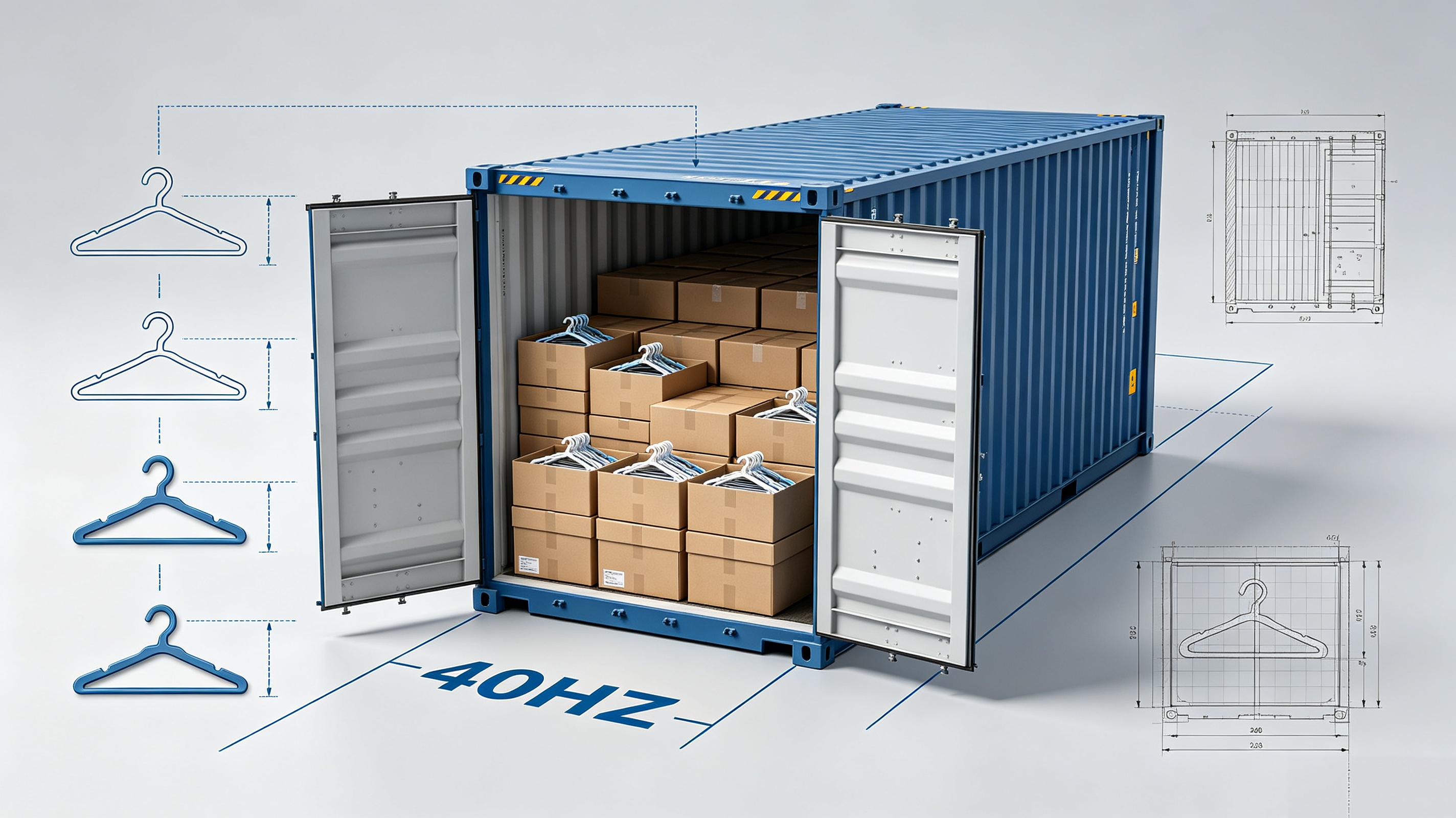
A 40HQ container has internal dimensions of approximately 12.032m long × 2.352m wide × 2.698m high. Customizing outer carton sizes to align with these measurements eliminates gaps between pallets and container walls.
- Calculate precise carton footprints: Design master cartons so that an exact number fit side-by-side across the container width and stack perfectly to the internal ceiling height.
- Balance quantity per carton: Pack enough hangers per box to minimize packaging material, but keep carton weights manageable for warehouse handling (typically 10–15kg per carton for plastic hangers).
- Use flat-top cartons: Uniform, rigid boxes stack stably without sagging, allowing full use of vertical container space.
3. Optimize Loading Patterns for Maximum Volume Utilization
Even with well-designed products and packaging, poor loading layout can waste significant space.
- Mix orientation strategically: Combine horizontal and vertical carton placement to fill irregular gaps left by hanger shoulder profiles.
- Fill voids with smaller SKUs: Use accessory boxes, hook packs or smaller hanger models to fill leftover space at container doors and along edges.
- Plan layer height: Calculate carton stack height to match 40HQ ceiling height exactly, avoiding unused vertical space.
When optimized correctly, plastic hanger 40HQ utilization can rise from an average 65% to 80–85%, translating to 20–30% more units per container.
40HQ Loading Reference by Hanger Type
Actual counts vary by hanger size, thickness and packaging, but these benchmark ranges give a baseline for budget planning:
表格
| Hanger Type | Approximate Quantity per 40HQ (optimized) |
|---|---|
| Slim standard PP display hangers | 25,000 – 32,000 pieces |
| Velvet-coated non-slip hangers | 18,000 – 24,000 pieces |
| Heavy-duty ABS suit hangers | 12,000 – 16,000 pieces |
| Hangers with trouser clips (knock-down) | 14,000 – 19,000 pieces |
Working with your manufacturer to calculate exact loading counts based on your specific hanger models ensures accurate freight budgeting.
Additional Loading Considerations
Weight Distribution
Plastic hangers are volume-limited rather than weight-limited in 40HQ containers. Even at maximum density, total cargo weight typically falls well below the 26–28 ton gross weight limit. Even so, distribute weight evenly along the container length to avoid transport imbalance and handling issues.
Damage Prevention
Maximizing density should not come at the expense of product protection. Use corner boards and appropriate strapping to prevent carton shift and crushing. For velvet hangers and custom-logo hangers, use inner polybags to protect surface finish during transit.
FCL vs LCL
For volumes that fill at least 70% of a 40HQ, full container load (FCL) is almost always more cost-effective than less-than-container load (LCL). FCL also reduces handling damage, simplifies customs clearance and speeds up transit time.
Bottom-Line Benefits of Optimized Loading
- 15–25% lower per-unit freight cost: More units per container directly reduce landed cost per hanger.
- Fewer damaged goods: Properly planned and secured loads experience less shift and crushing in transit.
- Simpler inventory planning: Predictable unit counts per container make receiving and stock allocation more accurate.
- Lower carbon footprint: Higher density means fewer containers shipped per order, reducing transportation emissions.
Final Conclusion
Container loading optimization is one of the highest-ROI opportunities in plastic hanger procurement. It does not require complex logistics overhauls — it starts with choosing stackable, space-efficient hanger designs, engineering cartons to match 40HQ dimensions and executing a planned loading pattern. For 2027, as freight costs and supply chain efficiency remain top priorities for apparel buyers, optimizing your hanger container load delivers measurable, immediate savings that go straight to your bottom line.
Dongguan Yongzhao Hardware Products Co., Ltd. specializes in space-efficient plastic hanger designs, including stackable display hangers and knock-down velvet hangers. We provide custom packaging engineering and detailed 40HQ loading calculations for every bulk order, helping customers maximize container utilization and minimize freight costs. Contact our team for a tailored loading plan and quotation for your 2027 hanger procurement.
EU PPWR 2027: What It Means for Plastic Hanger Sourcing and Packaging
2027 Hanger Budget Planning: How to Lock in Pricing and Avoid Supply Chain Volatility
Related Article