AI-Powered Merchandising: What It Means for Hanger Selection and Store Layout

AI-Powered Merchandising: What It Means for Hanger Selection and Store Layout
In 2026, AI-powered merchandising has moved beyond pilot programs to become a core operational tool for fashion retailers. Computer vision heatmaps, algorithmic SKU positioning and automated visual compliance audits are optimizing store layouts, boosting conversion and reducing manual work. Yet as retailers invest in AI software and sensor systems, many overlook the most fundamental piece of physical merchandising infrastructure: the hanger.

AI-generated merchandising strategies only deliver results when they execute reliably on the sales floor. Hangers are the physical interface between AI layout plans and actual garment displays. Their dimensional consistency, visual uniformity, shoulder precision and functional adaptability directly determine how well AI systems perform, and how much of their theoretical efficiency translates into real sales.
How AI Merchandising Is Redefining Store Layout Requirements
AI is changing four core rules of store planning, all of which raise new standards for hangers:
- Dynamic SKU repositioning Algorithms analyze real-time sales, foot traffic and dwell time data, then recommend weekly or even daily shifts in product placement. Static, category-locked hanger sets no longer work — layouts change fast.
- Automated visual compliance audits Computer vision cameras scan sales floors to verify alignment, spacing, brand standards and display neatness. Inconsistent hangers trigger false compliance flags and inaccurate reporting.
- Precision space optimization AI calculates revenue per linear meter of rail and optimizes hanger density down to the individual unit. Slightly uneven hanger widths throw off these calculations and reduce capacity.
- AI-linked inventory forecasting Smart inventory systems tie on-floor stock levels directly to replenishment schedules. Hangers that support automated counting and tracking eliminate manual stock checks.
Core Hanger Specifications for AI-Driven Retail
For hangers to work with AI merchandising systems, they must meet five key product criteria that go beyond basic display function:
1. Strict Dimensional Uniformity
AI vision and space-planning algorithms operate on precise measurements. If hangers vary in shoulder width, hook height or overall length, the system miscalculates rail capacity, misreads garment spacing and flags neatly hung stock as disorganized.
- Product requirement: One-piece injection-molded PP or ABS hangers with dimensional tolerances controlled to ±1mm
- Benefit: Ensures consistent spacing and predictable rail capacity, so AI density calculations match real-world results
2. Consistent Visual Identity
Automated compliance systems identify display order by recognizing hanger shape, color and orientation. Batch-to-batch color variation, asymmetric designs or mixed surface finishes cause the AI to misclassify SKUs or detect false defects.
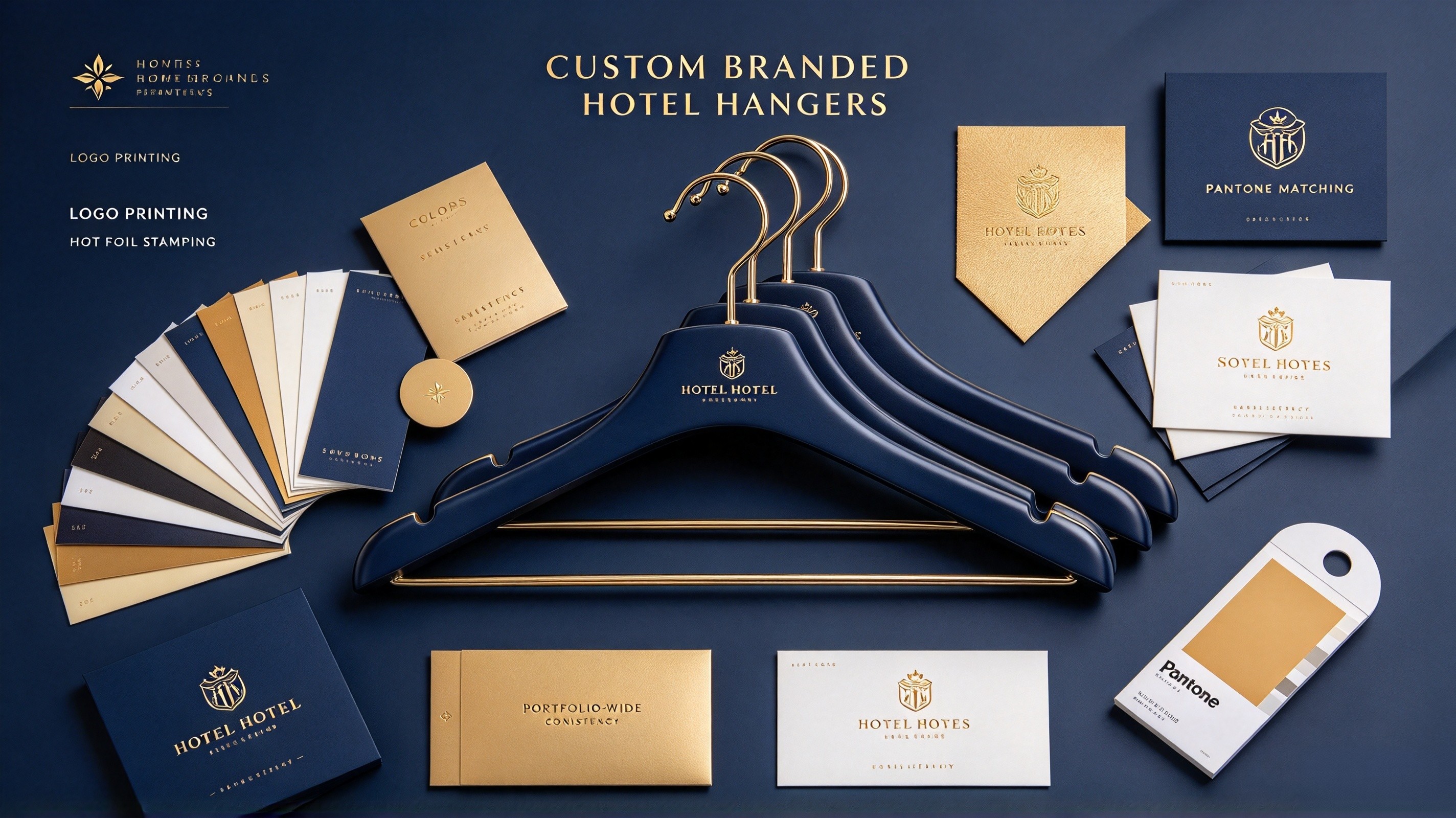
- Product requirement: Pantone-matched color across full production runs, symmetrical shoulder profiles and uniform surface finish (matte or gloss)
- Benefit: Eliminates visual noise for computer vision, delivering accurate compliance audits and cleaner heatmap data
3. Accurate Shoulder Geometry
AI merchandising tools often simulate garment drape and visual impact to plan feature displays. Ill-fitting hangers that create shoulder bumps, sagging collars or uneven hems distort these simulations and reduce display performance.
- Product requirement: Category-specific shoulder contours — wide reinforced shoulders for outerwear, tapered narrow shoulders for blouses and dresses, grooved shoulders for strap garments
- Benefit: Garments hang as intended, so AI-generated layout plans deliver the predicted visual and sales impact
4. Modular, Reconfigurable Design
AI-driven layout changes require fast, low-effort merchandising resets. Hangers locked to single product categories slow down remerchandising and erase AI efficiency gains.
- Product requirement: Universal hook system with interchangeable trouser clips, skirt clips and accessory bars
- Benefit: One hanger base adapts across categories, so retailers can execute AI layout shifts without purchasing all-new hanger sets
5. Optional Smart Identification Layer
For advanced AI inventory ecosystems, hangers can carry embedded identification to enable real-time stock tracking.
- Product requirement: RFID-tagged hangers or scannable QR codes printed on the shoulder
- Benefit: AI systems automatically count on-floor units, detect stock gaps and trigger replenishment without manual audits
Hanger Selection Guide by AI Merchandising Scenario
Different zones of an AI-optimized store call for different hanger solutions.
High-Traffic Hot Zones (AI Heatmap Prioritized)
These high-dwell-time areas, identified by AI heatmaps, showcase hero products and high-conversion SKUs. Displays must stay neat through frequent customer handling.
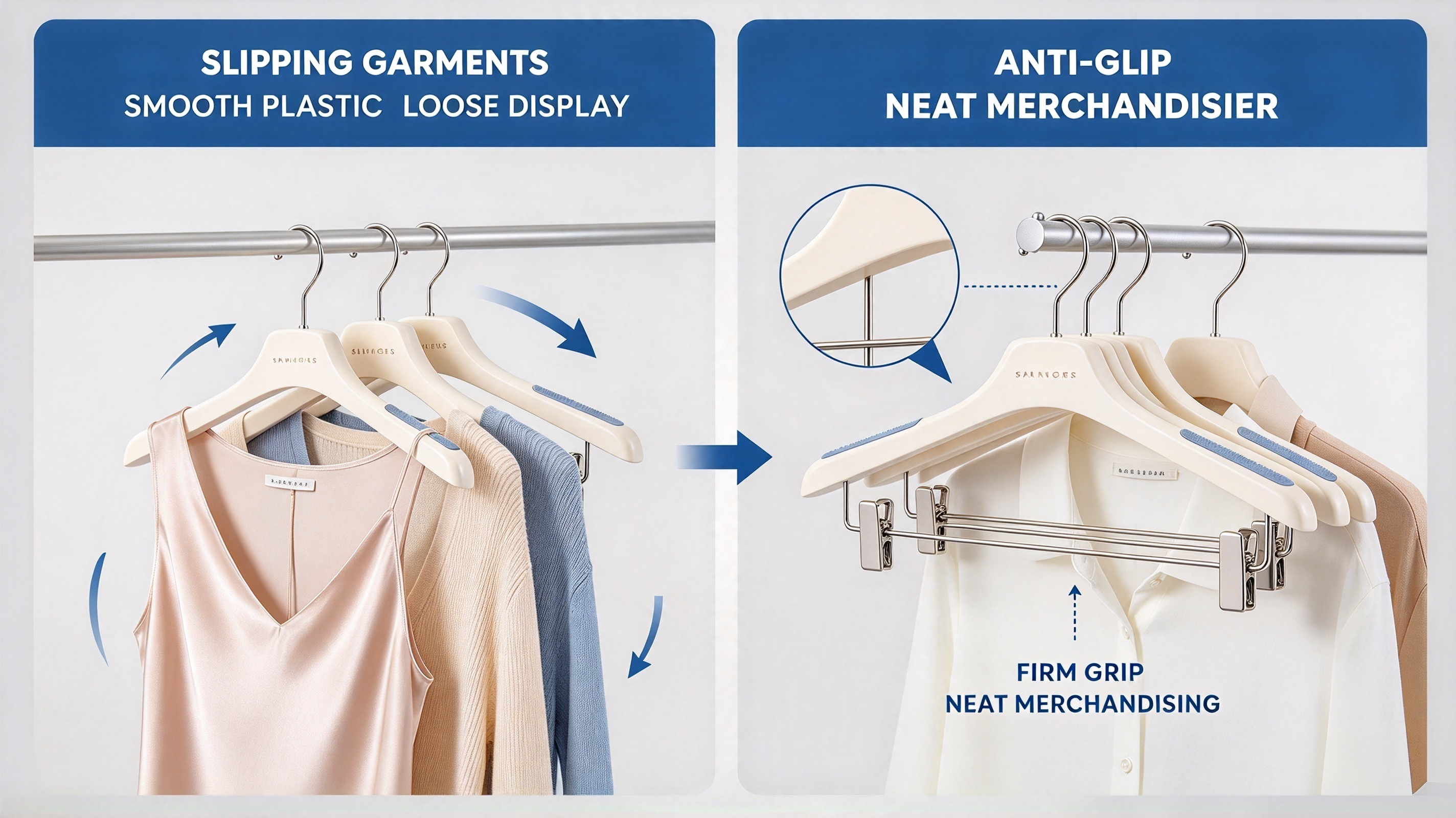
- Recommended hanger: Velvet-coated or rubber-paint plastic hangers
- Why it works: Non-slip surfaces keep garments in position despite frequent browsing, preserving the AI-planned layout. Uniform flocking or coating maintains a clean visual profile for camera-based auditing.
Automated Compliance Audit Zones
Areas monitored by visual AI for brand standards and display integrity demand maximum consistency.
- Recommended hanger: Heavy-duty ABS plastic hangers with precision dimensions
- Why it works: Rigid one-piece construction maintains shape and size over long-term use. Tight manufacturing tolerances ensure every hanger matches the AI system’s reference profile.
Dynamic Seasonal & Pop-Up Zones
AI-replanned seasonal displays and pop-up sections require fast, flexible reconfiguration.
- Recommended hanger: Modular PP hangers with clip-on accessories
- Why it works: Swap clips and bars to shift between tops, bottoms and coordinated sets. Lightweight, stackable design makes full layout resets fast and labour-efficient.
Back-of-House AI Inventory Zones
Stock rooms linked to AI replenishment systems need hangers that support automated tracking and high-volume handling.
- Recommended hanger: RFID-enabled heavy-duty PP hangers
- Why it works: RFID tags feed real-time stock data directly to the AI forecasting system. Reinforced construction withstands frequent picking, sorting and restocking cycles.
Optimizing Store Layout With a Hanger-First AI Strategy
To maximize return on AI merchandising investment, align your hanger strategy with these four principles:
- Standardize on one core hanger platform — A single base model with interchangeable accessories reduces AI calibration work and simplifies inventory management.
- Match hanger shoulder profile to category, not just aesthetics — Proper garment support improves display performance and gives AI more accurate visual data.
- Align hanger thickness with AI density targets — Slim-profile hangers maximize units per rail in high-density zones; wider shoulder hangers work better for feature displays.
- Invest in durability for long-term AI compatibility — Quality hangers retain their dimensions and appearance over years, avoiding repeated AI system recalibration.

Final Takeaway
AI-powered merchandising is not only a software upgrade — it is a full-stack retail upgrade. Hangers may seem like a small detail, but they are the physical foundation that makes AI layout plans work in the real world. Poorly made, inconsistent hangers create noise in AI data, distort compliance reports and limit the efficiency gains smart stores are built to deliver.
For 2026 retailers rolling out AI merchandising, upgrading hanger specifications alongside algorithm deployments ensures that every data-driven layout decision translates into clean, compliant, high-performing displays.
Dongguan Yongzhao Hardware Products Co., Ltd. manufactures precision-engineered plastic hangers built for AI-driven retail environments. With tight dimensional control, consistent Pantone matching and modular accessory systems, our hangers help retailers unlock the full value of their smart merchandising investments. Contact us to discuss hanger specifications tailored to your AI store layout.
From Store Display to Unboxing: Unified Hangers for Omnichannel Retail 2026
From Store Display to Unboxing: How One Hanger Type Works Across Omnichannel Retail
Related Article